
Quick Links: Letter, Hungry for More, Moral Authority, Making the Connection, Further Reading, Next Steps
Hungry for More: Letter Five
As we discussed in this week’s letter, it’s fair to say our culture no longer sees itself as “Christian.” Today, many describe our culture as “secular,” meaning there’s a sharp separation between Church and state, and the state no longer concerns itself with religion. But this explanation doesn’t tell the whole story.
I find the term “post-Christian” more helpful. Christianity still leaves its mark on every part of society, even if many no longer identify as Christian. Our culture is deeply shaped by our Judeo-Christian heritage, whether people acknowledge it or not. Some secularists may try to erase these influences, but they remain.
Another way to describe our culture is “neo-pagan.” I don’t mean this insultingly. We aren’t pagan in the old sense of worshiping nature gods, though some of that exists. But we do see that same old pagan resistance to acknowledge the supreme Creator-God who exists above nature that makes demands “on me.” At the same time, we see the pagan impulse to emphasize what is close “to me,” especially my feelings and sensual self.
However, to avoid offending people by calling them “neo-pagan,” I think “gnostic” is a better term. Gnosticism has always been a kind of anti-gospel, denying Christ and promoting secret, inner knowledge beyond objective truth. To fully grasp how gnosticism shapes our culture today, we need to explore it more deeply.
Historically, Gnosticism emerged alongside the early Church, shaped by a mix of Eastern mysticism and Greek philosophy, especially Platonism. It wasn’t just an outside influence—it grew within the same cultural and religious world as Christianity. That’s why it often sounds spiritual and can even borrow language from the Gospel.
But Gnosticism offers an alternative message. It emphasizes secret knowledge, personal enlightenment, and escape from the material world, rather than the biblical message of salvation through Christ, the goodness of creation, and the hope of resurrection. Though it may present deep spiritual ideas, Gnosticism ultimately stands in opposition to the Gospel at its core.
The Cosmic Triangle
To understand this more fully, we need to explore the idea of cosmology. Cosmology is simply the way we make sense of the world—how we understand life, the universe, and our place in it. Whether we think about it consciously or not, everyone has a cosmology.
There are three key parts that shape every cosmology and, in turn, shape how we live. These three parts frame our common human experience:
Component #1: The “Beyond
This is the spiritual realm that exists outside of ourselves—the world of God, the gods, or anything considered higher than us. It’s often called transcendence.
Component #2: Space/Matter
This is the physical world—the earth, the universe, everything we can touch, see, and experience with our senses.
Component #3: Time
Time can be understood in two ways: as linear (with a clear beginning and end, like the Christian story of creation to new creation) or as cyclical (like the turning of the seasons, endlessly repeating).
How a person understands these three components—whether they think about it deeply or not—directly shapes how they live, what they value, and what they hope for. In fact, we can evaluate any philosophy or religion by asking how it deals with these three parts.
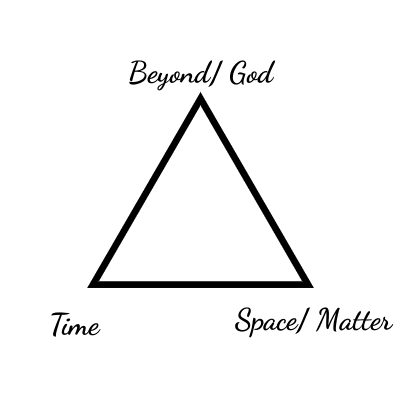
I like to picture this as a cosmic triangle:
- At the top: The Beyond (transcendence)
- Bottom right: Space/Matter (the physical world)
- Bottom left: Time (the flow or cycle of history)
This triangle gives us a simple but powerful way to understand how people see the world—and where Gnosticism fits in.
Let’s begin with Catholicism.
For Catholics, transcendence means there is a Creator God who exists above and beyond space, matter, and time. He is not distant or uninterested—He has revealed Himself in history, through Scripture, as a God who makes covenants and seeks a personal relationship with His people. Because He is God, it is natural and right to worship Him.
When it comes to space and matter, Catholicism teaches that both the spiritual and material worlds were created good by God. Humanity was given “dominion” over creation—not to exploit it, but to care for it, like a gardener tending a garden. Even though sin entered the world (the Fall) and we lost our original harmony, both humanity and the physical world remain essentially good and are capable of being redeemed.
This belief—that matter is good—is central to the Catholic sacramental worldview. God uses the physical world to save us: Christ became truly human, and through material things like water, oil, bread, and wine, we receive grace in the sacraments.
Catholicism also has a unique view of time. Time is both cyclical and linear:
- It is cyclical in the sense that the rhythms of nature and the liturgical calendar connect us to the goodness of the created world and to God’s saving work throughout history.
- It is linear because time has a clear beginning and a promised end. History is going somewhere. God is active within time, and each of us participates in this story. Our choices matter, and we will one day stand before God in final judgment.
What’s striking about the Catholic worldview is how it holds all three parts of the cosmic triangle together in harmony:
- Transcendence is real and personal.
- Matter is good and essential to salvation.
- Time is meaningful and moving toward a conclusion.
This balanced, integrated cosmology is at the heart of Catholic faith and is vital to our understanding of salvation.
Gnosticism
We can now see from this simple framework how cosmology shapes the way we live. Our understanding of transcendence, matter, and time deeply influences our choices, values, and purpose. Let’s now look at how the gnostic cosmology contrasts with the Catholic one.
In Gnosticism, transcendence is very different. There is no Creator God who lovingly stands above the world, enters into history, and calls us into relationship. Instead, the “transcendental” realm is seen as a distant, impersonal spiritual plane, accessible only to a select few who possess special inner knowledge—what the Gnostics called gnosis. This knowledge is not about truth revealed by God, but about personal, mystical insight that supposedly leads to spiritual freedom.
For Gnosticism, the material world is either irrelevant or fundamentally evil. This thinking is heavily influenced by Greek philosophy, especially Plato, who taught that the material world is an illusion and that the soul’s goal is to escape it. Eastern religions like Buddhism also echo this idea, seeing salvation as freedom from the physical world. In modern Western culture, this gnostic view shows up in the way we try to dominate and manipulate nature—often seeing it as something to control, rather than something to steward. The body is often treated as a barrier to true freedom, something to overcome, reshape, or escape.
When it comes to time, Gnosticism, like many forms of ancient paganism, sees it as unimportant. There is no larger story, no shared destiny, no final judgment, and no accountability. Without this structure, life can feel aimless. Reason and logic lose their grounding, and natural order is often rejected. People are left to create their own meaning, often guided by their feelings alone.
This rejection of objective truth and natural limits frequently leads to a self-centered focus on emotions and desires. In modern culture, this is especially visible in areas like unrestrained sexual expression—if something feels right, it is assumed to be right. This mindset, which mirrors ancient pagan practices, leads us to become slaves to our own feelings and appetites, disconnected from reason, community, and deeper purpose.
The Catholic Church and Culture
The Catholic Church is open to all cultures because it is open to everything that makes us fully human. Wherever the Church is present, there will naturally be a give and take between the Church and the surrounding culture. The Church is not anti-culture. In fact, it seeks to embrace what is good, true, and beautiful in every culture. Yet, at the same time, the Church is always, to some degree, counter-cultural. It must constantly remain faithful to its revealed cosmology, as we have described, and must continually challenge the false cosmologies that arise in the world.
The Church is always in dialogue with the world, but it cannot surrender its understanding of transcendence, the goodness of matter, or the meaningfulness of time. It must speak into the cultures it encounters with both respect and courage, offering the Gospel as the true path to human flourishing and salvation.
This ongoing mission is beautifully reflected in Church teaching, especially in documents like Evangelii Nuntiandi by Pope Paul VI and Gaudium et Spes, particularly Part Two, Chapter 2, which addresses the proper development of culture.
Ultimately, it is only in the Catholic Church that we find the full integration of the cosmic triangle:
- Transcendence is fully revealed in Christ, the Eternal Son.
- Matter is affirmed in the Incarnation—Christ truly took on human flesh and continues to sanctify the material world through the sacraments.
- Time is redeemed by Christ, who is the Lord of history and who will bring all things to their fulfillment.
In Christ, all three—transcendence, matter, and time—are perfectly united. It is in Him that we find the harmony and wholeness our hearts seek.
Moral Authority
Sources for Catholic Teaching
Scripture References
2 Timothy 3:16 All scripture is inspired by God and[a] profitable for teaching, for reproof, for correction, and for training in righteousness
Romans 15:4 For whatever was written in former days was written for our instruction, that by steadfastness and by the encouragement of the scriptures we might have hope.
Colossians 2:7 rooted and built up in him and established in the faith, just as you were taught, abounding in thanksgiving.
Deuteronomy 6:6-9 And these words which I command you this day shall be upon your heart; 7 and you shall teach them diligently to your children, and shall talk of them when you sit in your house, and when you walk by the way, and when you lie down, and when you rise. 8 And you shall bind them as a sign upon your hand, and they shall be as frontlets between your eyes. 9 And you shall write them on the doorposts of your house and on your gates.
Psalms 19:7-10 The law of the Lord is perfect, reviving the soul; the testimony of the Lord is sure, making wise the simple; the precepts of the Lord are right, rejoicing the heart; the commandment of the Lord is pure, enlightening the eyes; the fear of the Lord is clean, enduring forever; the ordinances of the Lord are true, and righteous altogether. More to be desired are they than gold, even much fine gold; sweeter also than honey and drippings of the honeycomb.
Catechism References
909 “Moreover by uniting their forces let the laity so remedy the institutions and conditions of the world when the latter are an inducement to sin, that these may be conformed to the norms of justice, favoring rather than hindering the practice of virtue. By so doing they will impregnate the culture and human works with a moral value.”
2524 The forms taken by modesty vary from one culture to another. Everywhere, however, modesty exists as an intuition of the spiritual dignity proper to man. It is born with the awakening consciousness of being a subject. Teaching modesty to children and adolescents means awakening in them respect for the human person.
2525 Christian purity requires a purification of the social climate. It requires of the communications media that their presentations show concern and respect and restraint. Purity of heart brings freedom from widespread eroticism and avoids entertainment inclined to voyeurism and illusion.
Vatican Documents
The Second Vatican Council’s Gaudium et Spes, which engages with the modern world and culture, and the Pontifical Council for Culture’s documents, such as Pope John Paul II’s 1982 establishment of the council itself. Other significant documents include Pope John Paul II’s Redemptoris Missio and Pope Francis’ Evangelii Gaudium, which discuss inculturation—the integration of the Gospel with a people’s culture—within a pastoral context.
Second Vatican Council (1962-1965)
- Gaudium et Spes: This “Pastoral Constitution on the Church in the Modern World” is a pivotal document that brought the Church into dialogue with contemporary culture and society, acknowledging the gap that had formed and the impact of scientific and technological progress.
- Nostra Aetate: This “Declaration on the Relation of the Church with Non-Christian Religions” focuses on the Church’s relationship with other faiths and cultural traditions, promoting understanding and respect.
- Sacrosanctum Concilium: The “Constitution on the Sacred Liturgy” allowed for the use of vernacular languages in worship, recognizing the value of different cultural and traditional rites and encouraging community participation.
Post-Conciliar Documents
- Evangelii Nuntiandi: Pope Paul VI’s 1975 Apostolic Exhortation on Evangelization in the Modern World highlights the relationship between the Gospel and culture, stating that while independent, the Gospel can permeate and enrich cultures.
- Redemptoris Missio: John Paul II’s 1990 encyclical discusses inculturation within the broader context of mission, emphasizing the integration of the Gospel’s permanent values into a people’s culture.
- Evangelii Gaudium: Pope Francis’ 2014 apostolic exhortation further develops themes of inculturation within the Church’s pastoral strategy, encouraging a dynamic integration of faith and culture.
- Dignitas Infinita: This 2024 declaration from the Dicastery for the Doctrine of the Faith addresses contemporary human dignity and its relation to God, and while not a primary document on culture, it provides a doctrinal framework for recognizing the inherent dignity within diverse cultures.
Other Key Aspects
Pontifical Council for Culture
- Founded by John Paul II in 1982, the council’s existence and its various addresses to members demonstrate a direct engagement with the concept of culture.
This 1994 Vatican instruction addresses liturgical inculturation specifically, outlining how the process of integrating the Gospel into the permanent values of a people’s culture should occur.
Making the Connection
A Real-Life Example
There are many families whose members have experienced the doubt, soul searching, and crises of faith that sometimes comes with trying to mesh one’s faith life with the pervasive influences of the surrounding culture. The story of one such family is particularly poignant. To protect their privacy, the names of the family members have been changed, but the story is true. The family consists of a dad, Steve, a mom, Mary Ann, a daughter, Jenna, and a son, Billy. Steve was raised in a very strict Catholic family. They attended Mass regularly as a family. He was very involved in his Catholic church as a youngster through his teen years, making great friends through the Lifeteen program. He joined the Navy shortly after high school, and began to read Scripture daily, even though he stopped attending Mass during this period. When Steve was assigned to a location where his duties involved guarding very dangerous criminals, he reconnected with his faith and developed a love for scripture study and the Rosary. After his tour, he was stationed in Virginia and met a woman, married and had two children. Over time he realized that his wife was anti-Catholic, and he was influenced to move away from his faith. He ultimately was sent away on tour again, and once again reconnected with his faith and the church. Steve separated from his wife, divorced, and considered priesthood. He attended training for further involvement with the Catholic faith as he searched for direction.
Steve then returned from his second tour of duty, and reconnected with an old high school friend, Mary Ann. They dated and married. Mary Ann agreed to convert to Catholicism. In the early years of their marriage, they attended the local Catholic Church, but they struggled with a perceived lack of faith among the clergy and parishioners. At the same time, Steve began attending college, which also caused him to question his faith. As he continued through the undergraduate program, and then into higher degrees, his impression was that academia tends to influence students to question their religious beliefs, referring to them as societal constructs, and pushes people towards secularism. He continued to question the existence of God, and that Jesus Christ is the son of God. Steve and Mary Ann stopped attending Mass during this period. The cultural pressures upon every Catholic to renounce their faith and join the crowd are significant and unrelenting.
After several years, Steve and Mary Ann had two children, and Mary Ann was facing an upcoming surgery for which they were not at all financially prepared. He prayed for the first time in 12 years. He prayed to Mary, and promised that he would return to his faith if the financial problems could be resolved. The very next morning Steve received a call from the hospital telling him that all the bills had been paid. That was the sign he needed from God. He returned to his Catholic faith, and began attending Mass regularly again. No sooner did this happen then his 5th grade daughter, Jenna, announced that she was bisexual. In addition, his son, Billy, reported that he was being periodically bullied in elementary school because he is white and straight. Steve observed that the school their children attended was highly politicized. At this school the kids are made to feel that if they aren’t a member of an oppressed group then they are part of the problem. They are encouraged to identify as being disadvantaged in some way. They are told that they are not authentic if they haven’t lived and experienced oppression. Steve finally moved the family to a more conservative school district where these pressures are not so prominent.
Mary Ann had never been particularly devout, and stopped practicing her Catholic faith when her husband did, so many years ago. She actually returned to her pagan beliefs, even constructing an altar to pagan gods in their home. However, very recently, Mary Ann started having recurring dreams about her aunt, who had died some time ago. She repeatedly dreamed that her aunt was burning and crying out for help. She also dreamed that her father would tell her that she could help her aunt, but she did not know how. Steve had been actively praying for his wife’s conversion, even enlisting the aid of the nuns at the Carmelite convent, Carmel of Jesus, Mary and Joseph, Fairfield, in Fairfield, Pennsylvania. Steve began talking to Mary Ann about her dreams, suggesting that she is seeing her aunt in Purgatory, and that she can help her aunt by praying for the salvation of her soul. Mary Ann began to consider this, initially concluding that pagan idols were images that God used to soften peoples’ hearts, and that saints used this idea to help convert pagans to God. This was therefore a process by which God was bringing her to Himself. Mary Ann accepted this argument. Seven days before Pentecost, she was sitting alone in her bedroom. She saw a ball of fire descend from the corner of the room and speak to her. She concluded that God was speaking to her. Mary Ann revealed that in a few moments she learned everything she needed to know about the truths of Catholicism from God. She is now a practicing Catholic.
Their son, Billy, observing the transformation of his parents, began to inquire about the Catholic faith. He started attending Mass with them, and recently proclaimed that he wanted to become Catholic. Billy expressed a strong and sincere desire for the Eucharist. He went through the RCIA program this past year and recently received his first Reconciliation, and then his first Eucharist.
Their daughter, Jenna, is a self-professed bisexual atheist. Her parents are quietly modeling a faithful Catholic life for Jenna, and having conversations about their faith with her when possible. Steve believes that there is never a moment when we are cut off from God, and is waiting patiently for the time when Jenna might be open to conversion. Steve believes that conversion happens by the grace of God through intercession and prayer by others. He refers to the experience of St. Monica, the mother of St. Augustine, as an example of this. She prayed her entire life for the conversion of her husband, son (St. Augustine), and grandson. Her husband converted at the end of his life, and her son and grandson converted as well. One experiences conversion through prayer, patience, example, and education.
Further Reading
Additional Reading Materials
Kresta, Al. Dangers to the Faith: Recognizing Catholicism’s 21st-Century Opponents. Huntington, Indiana: Our Sunday Visitor Publishing Division, 2013.
The author of this book is a former Protestant minister who converted to Catholicism. His book is described in the following way: “Whether it’s New Atheism or ancient heresies like Gnosticism, the challenges to the Catholic Church are coming from all angles. The proponents of such movements employ arguments that appeal not just to reason, but also to our emotions, and even to the common doubts that can plague many Catholics. Combating these errant worldviews requires deep knowledge of the faith and the willingness to unflinchingly tell the truth. That’s where Al Kresta (the author) comes in.”
Kreeft, Peter. How to Win the Culture War: A Christian Battle Plan for a Society in Crisis. Downers Grove, Illinois: InterVarsity Press, 2002.
In this book’s description it says, “Many Christians have fallen into the trap of proclaiming ‘Peace! Peace!’ when there is no peace. Hiding their eyes from the pressing issues of the day, they believe that resistance to the prevailing culture is useless. At the same time, other Christians have been too quick to declare war, mistaking battlefield casualties as enemies rather than victims… Christians must understand the true nature of the culture war – a war between the culture of life and the culture of death”. The author presents the real enemies, the key battlefields, and strategies for engagement. “For those who hope in Christ, victory is assured, because good triumphs over evil and life conquers death. Love never gives up. Neither must we”.
Next Steps
Ready to Take the Next Step?
How can we help our families become more comfortable talking about difficult issues? Study, Prayer and Practice!
How can we distinguish between an opinion and Revelation? Study, Prayer and Practice!
📖 Study
Simply put, in order to be counter-cultural, we must strive to live God-centered lives marked by humility, detachment, and service to others.
This means we must prioritize God; embrace humility; practice detachment from material good, status and recognition; live a life serving the needy, sharing blessings, and mirroring Christ’s love in concrete acts of generosity and care; and upholding Catholic social teachings by working for justice and the common good, countering the self-centeredness of individualism.
However, the brevity and simplicity of this guidance belies the difficulty of doing any one of these things in the face of a society that is providing a barrage of messaging to reinforce the importance of “self.” It is easy to know what we should do, but how do you find the strength to make choices that may leave us feeling like outsiders?
Peter Lencioni provides this helpful analogy in The Challenge of Being Counter-Cultural:
A final analogy might be helpful here. To be a follower of Christ in the modern world is like being a fish trying to swim upstream. Why is it a good thing for those of us swimming against the current to do so in groups with others who are headed in the same direction? Because when you’re working so hard to fight that current, it’s helpful to look around and see others doing the same. If nothing else, it reminds us that the work is hard for us all and that to relax and stop fighting is to float with the current. This leads us to have a false sense of security believing that at least we’re going slower in the wrong direction than the fish that are swimming downstream. Of course, if we’re going in the wrong direction, it doesn’t matter how fast we’re moving.
💖 Prayer
We can use the closing remarks from Peter Lencioni’s article to petition God to help us live up to this image:
May God help us be the fish that swim hard against the current or the birds who avoid being tethered by a twine, or better yet, men and women who are comfortable being criticized or ridiculed for having the courage to stand together and be counter-cultural.
✝️ Practice
At Saint Joseph Catholic Church, we have a vision of being the spiritual, moral and social heart of Eldersburg/Sykesville through encounters with Jesus Christ. As such, we will be fostering the very community we seek – others who will help strengthen and encourage us as we strive to swim against the current.
You can be part of this vision in two ways:
- Attend one (or all) of the events that SJCC hosts for the parish we serve. Invite friends and neighbors from Sykesville, Eldersburg, and the surrounding areas, so they understand that they, too, are part of this vision.
- Rely on this growing church family for support in swimming against the current. Share your concerns about immoral or unjust things that you see happening in the secular culture around us, and seek strength and camaraderie to say, “We reject this.”